Sunday, June 23, 2013

Bayou to Bay:

Where is Your Watershed?

Last week, I participated in a new series of courses entitled "Headwaters to Baywaters," offered by Get Outdoors Houston! and the Environmental Educators Exchange. 

I began my watershed journey Wednesday with a pontoon boat tour (with Buffalo
Bayou Partnership) along Buffalo Bayou, Houston's birthplace.  We started at Allen's Landing.  In 1836, the Allen brothers selected the convergence of Buffalo Bayou and White Oak Bayou as the site for a port that would become the new city's hub of activity and commerce (hence, Commerce Street and the Merchants and Manufacturers Building).


The brothers laid out the city on a grid, oriented not to a compass but instead aligned with the Bayou.  Tidally influenced rather than rain dependent, Buffalo Bayou provided a depth of at least ten feet and included a natural turning basin where it joined White Oak Bayou.  The thriving port offered a place to load cotton, rice, salt, molasses, lumber, and other Texas goods onto ships for transport.


From Allen's Landing, we travelled east to the Ship Channel, a widened and deepened section of Buffalo Bayou that links ocean-going vessels from Houston to the Gulf of Mexico via Galveston Bay.  Now nicknamed "Bayou City," Houston was once referred to as "Drawbridge City."  Beginning with an iron draw bridge in 1883, Houston eventually constructed a series of ten drawbridges over Buffalo Bayou between Main Street and the Turning Basin.  The bridge shown above was built by Joseph Strauss, the engineer who would later design the Golden Gate Bridge in San Francisco.

Buffalo Bayou is home to an impressive coastal ecosystem.  However, our waterways must constantly battle floatable debris and non-point-source pollution.  Last year, the Buffalo Bayou Partnership skimmer boat collected 3000 cubic yards of trash from the bayou.  Trash that blows into streets washes into storm sewers, flows into our bayous, and floats out into the Bay.  Any liquids (paint, oil, cleaners, etc.) dumped onto streets or parking lots or into the storm sewers also find their way into the Bay, untreated.  Similarly, any pesticides and fertilizers we use on our lawns eventually washes off into the Bay.

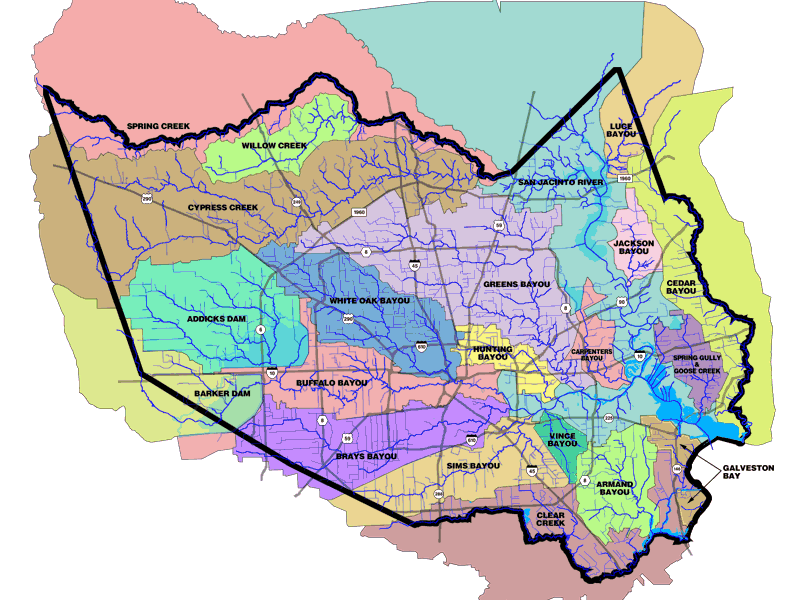
We continued our watershed journey on Friday at Galveston Bay.  We began by examining watershed maps to identify our individual watershed addresses.  It may seem obvious that Houston's water ultimately drains into the Bay and that water from the five states bordering the Gulf finds its way into the Gulf of Mexico.  However, the Gulf of Mexico watershed covers almost two million square miles.  It is watershed for 31 states (including New York and Montana!) and 33 rivers.  Most of the United States drains into the Gulf of Mexico.


Next, we headed outdoors with Artist Boat to investigate the Bay.  We used a seining net to discover fish and invertebrate marine life that exists in the protected bay waters.


We performed a series of water quality tests, including temperature, salinity, turbidity, and pH.  Then we hopped in kayaks and paddled into the estuary.


I always love the sight of our (formerly endangered) brown pelicans!


After paddling for a while, we stopped to do some watercolor painting.


warmouth


Kayaking and water-coloring to learn about local coastal ecology and watersheds--my kind of professional development!


Explore Our Watershed
Buffalo Bayou boat tours
Port of Houston Sam Houston boat tour free
Artist Boat public kayak adventures
Make your own seine net
City of Houston water quality report
Join Bayou Preservation Association for an on-the-water clean-up event
Help reduce floatable waterway pollution

Wednesday, June 12, 2013

A big bone

Sometimes, in the blistering heat of a Seymour summer, it's just nice to sit in one place and move dirt.  Last week, Chris found more of Willi, our amazing articulated dimetrodon--the missing clavicle.  My assignment was to move dirt from what used to be our path into the quarry.  The fossils on the surface in this area are not "in place."  Instead, the whole section is slumping down and eroding out.  As I dug, I found dead leaves from the tree above me mixed in with the upper layers of matrix.  Because the layer has been compromised, this means that when I found small bones, their location does not provide very helpful information as they are no longer in their original location.  We mark the collection bag with the name of the area, but we don't need to map the location of the finds. 

So I was peacefully sweating and quietly moving dirt and rocks . . . until I found a big hunk of bone.  A BIG hunk of bone.  Now I'd need to work very slowly and carefully.


As I brushed away the surrounding matrix to reveal the fossil, a tell-tale shape began to reveal itself.  Chris and Dave confirmed that it is an unusually large dimetrodon humerus.

Tuesday, June 04, 2013

Twisted

Do you ever have one of those moments when you somehow manage to channel someone wiser than yourself and creatively solve a problem--with amazing results?  In my case, I think it was some magical combination of Maria Montessori and Donna Bryant Goertz, author of Children Who are Not Yet Peaceful
Discarded weapon-like bent paperclips were appearing in little nooks and crannies around the room . . . and our paperclip basket had a parasite.  Finally, I wised up and took my concern to our class meeting.  "I keep finding paperclips like this.  Paperclips are specially designed to fasten papers together.  When they are bent, they become dangerous and no longer serve their purpose.  Why is this happening to them?"  One brave, honest voice quietly volunteered, "It's fun to bend them." And my mind said, "Well, duh.  It kinda is."

Sooo . . . (and this is when the wisdom channeling happened) I proposed that if we agreed to save paperclips for their intended purpose, I would put a tray of wire with pliers and wire-cutting tools on the art shelf for sculpture. 

I think this is what Dr. Montessori meant when she advised us to "follow the child."  Pay attention to what the child's choices/behaviors are telling you about their needs.  In this case, I had to quite literally hear it.  "It's fun to bend them."  When you recognize a child's need, provide appropriate, constructive ways for the child to meet those needs.


Tada!  The paperclip parasite was instantly eliminated,


creative cat


and fantastic sculpture took its place!


More amazingly, this fostered such an affinity for sculpture that not long after, a student brought in a gift for the class--a container of brightly colored flat, rigid plastic organic shapes that can be fastened together to create sculpture. 


The end-of-year timing could not have been more perfect.  Having something new and engaging on the art shelf was perfect as testing dragged on for over a week in May and we were nearing the last weeks of school.  One child even created "a dimetrodon eating a shark" (and me without my camera!)  Ahhh.  Art.