Wednesday, July 03, 2013

Message in a bottle

With e-mailing, texting, tweeting, posting to Facebook, Instagramming, blogging, Skyping, and all the other electronic methods of getting in touch with friends and family, it's easy to forget the joy of opening a physical mailbox to find a piece of actual, real mail.

I've been thinking about a friend who needs a pocket of joy in her life.  She's going through one of those times when life moves from drizzling to thunderstorms to rain with few bright spots among the clouds.  So when I stumbled across Happy Mail, I thought immediately of sending her a bit of happy!

What fun!  I felt like such a sneaky little Happy Elf, assembling this gift.  I started with a Gatorade bottle, leftover from my Bayou to Bay adventure.  Next, I headed to a dollar store where I found the lovely rainbow arrow-shaped sticky tabs.  Aren't they cheerful?  I picked them up because I couldn't resist their rainbow beauty, but I was really hoping to find some fun, unique sprinkles to send.  This particular friend is an avid baker with a sizable (somewhat secret) stash of sprinkles of all sorts.  Sadly, at the cooks' store, the sprinkles were pretty typical fare--nothing she wouldn't already have in her vast collection.  However, I did find food coloring markers.  These would go well with my rainbow theme! 

To round out the gift, I added a heart-shaped rainbow card (rolled up to fit into the bottle) and some sunshine-shaped confetti.  At the last moment, I found a little heart-shaped rainbow eraser.  Perfect!

Despite some negative naysayers ("I don't know if you can do that . . . I'm worried you might be wasting your money." "Maybe you should just put it in a box." "They [postal employees] may just throw it away."), I screwed the lid on tightly, added postage, and (after some consideration about which post office might have the most funky-mail friendly postal employees) popped the bottle into mail.  Hee, hee! 

Three days later, I received a phone message.  "Hello!  I got the very very very cutest amazing little bottle of love today!  . . . When I opened the mailbox, it was there and I went 'What is that?!'  It was awesome!  I wish you could have seen my face.   . . . I loved every single thing." 

It worked!  Now I want to send more!  Who should be the next recipient of Happy Mail?  I am really wishing I had saved (instead of recycled) all those Gatorade bottles we accumulate when we're out in the heat, digging!

What kind of happiness will you mail?  Give it a try!  Check out the details on sending Happy Mail, write a real letter, maybe do a little mail art, and send some love to someone's mailbox! 

Sunday, June 23, 2013

Bayou to Bay:

Where is Your Watershed?

Last week, I participated in a new series of courses entitled "Headwaters to Baywaters," offered by Get Outdoors Houston! and the Environmental Educators Exchange. 

I began my watershed journey Wednesday with a pontoon boat tour (with Buffalo
Bayou Partnership) along Buffalo Bayou, Houston's birthplace.  We started at Allen's Landing.  In 1836, the Allen brothers selected the convergence of Buffalo Bayou and White Oak Bayou as the site for a port that would become the new city's hub of activity and commerce (hence, Commerce Street and the Merchants and Manufacturers Building).


The brothers laid out the city on a grid, oriented not to a compass but instead aligned with the Bayou.  Tidally influenced rather than rain dependent, Buffalo Bayou provided a depth of at least ten feet and included a natural turning basin where it joined White Oak Bayou.  The thriving port offered a place to load cotton, rice, salt, molasses, lumber, and other Texas goods onto ships for transport.


From Allen's Landing, we travelled east to the Ship Channel, a widened and deepened section of Buffalo Bayou that links ocean-going vessels from Houston to the Gulf of Mexico via Galveston Bay.  Now nicknamed "Bayou City," Houston was once referred to as "Drawbridge City."  Beginning with an iron draw bridge in 1883, Houston eventually constructed a series of ten drawbridges over Buffalo Bayou between Main Street and the Turning Basin.  The bridge shown above was built by Joseph Strauss, the engineer who would later design the Golden Gate Bridge in San Francisco.

Buffalo Bayou is home to an impressive coastal ecosystem.  However, our waterways must constantly battle floatable debris and non-point-source pollution.  Last year, the Buffalo Bayou Partnership skimmer boat collected 3000 cubic yards of trash from the bayou.  Trash that blows into streets washes into storm sewers, flows into our bayous, and floats out into the Bay.  Any liquids (paint, oil, cleaners, etc.) dumped onto streets or parking lots or into the storm sewers also find their way into the Bay, untreated.  Similarly, any pesticides and fertilizers we use on our lawns eventually washes off into the Bay.

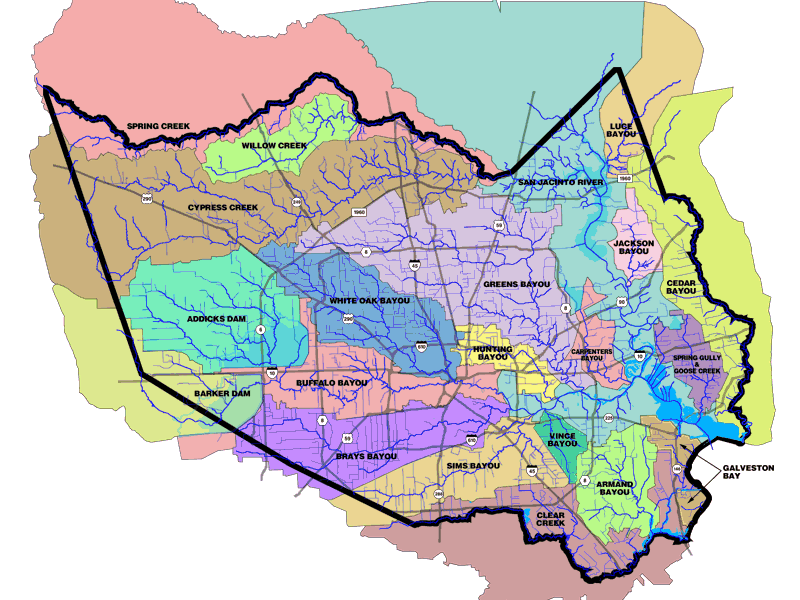
We continued our watershed journey on Friday at Galveston Bay.  We began by examining watershed maps to identify our individual watershed addresses.  It may seem obvious that Houston's water ultimately drains into the Bay and that water from the five states bordering the Gulf finds its way into the Gulf of Mexico.  However, the Gulf of Mexico watershed covers almost two million square miles.  It is watershed for 31 states (including New York and Montana!) and 33 rivers.  Most of the United States drains into the Gulf of Mexico.


Next, we headed outdoors with Artist Boat to investigate the Bay.  We used a seining net to discover fish and invertebrate marine life that exists in the protected bay waters.


We performed a series of water quality tests, including temperature, salinity, turbidity, and pH.  Then we hopped in kayaks and paddled into the estuary.


I always love the sight of our (formerly endangered) brown pelicans!


After paddling for a while, we stopped to do some watercolor painting.


warmouth


Kayaking and water-coloring to learn about local coastal ecology and watersheds--my kind of professional development!


Explore Our Watershed
Buffalo Bayou boat tours
Port of Houston Sam Houston boat tour free
Artist Boat public kayak adventures
Make your own seine net
City of Houston water quality report
Join Bayou Preservation Association for an on-the-water clean-up event
Help reduce floatable waterway pollution

Wednesday, June 12, 2013

A big bone

Sometimes, in the blistering heat of a Seymour summer, it's just nice to sit in one place and move dirt.  Last week, Chris found more of Willi, our amazing articulated dimetrodon--the missing clavicle.  My assignment was to move dirt from what used to be our path into the quarry.  The fossils on the surface in this area are not "in place."  Instead, the whole section is slumping down and eroding out.  As I dug, I found dead leaves from the tree above me mixed in with the upper layers of matrix.  Because the layer has been compromised, this means that when I found small bones, their location does not provide very helpful information as they are no longer in their original location.  We mark the collection bag with the name of the area, but we don't need to map the location of the finds. 

So I was peacefully sweating and quietly moving dirt and rocks . . . until I found a big hunk of bone.  A BIG hunk of bone.  Now I'd need to work very slowly and carefully.


As I brushed away the surrounding matrix to reveal the fossil, a tell-tale shape began to reveal itself.  Chris and Dave confirmed that it is an unusually large dimetrodon humerus.

Tuesday, June 04, 2013

Twisted

Do you ever have one of those moments when you somehow manage to channel someone wiser than yourself and creatively solve a problem--with amazing results?  In my case, I think it was some magical combination of Maria Montessori and Donna Bryant Goertz, author of Children Who are Not Yet Peaceful. 
Discarded weapon-like bent paperclips were appearing in little nooks and crannies around the room . . . and our paperclip basket had a parasite.  Finally, I wised up and took my concern to our class meeting.  "I keep finding paperclips like this.  Paperclips are specially designed to fasten papers together.  When they are bent, they become dangerous and no longer serve their purpose.  Why is this happening to them?"  One brave, honest voice quietly volunteered, "It's fun to bend them." And my mind said, "Well, duh.  It kinda is."

Sooo . . . (and this is when the wisdom channeling happened) I proposed that if we agreed to save paperclips for their intended purpose, I would put a tray of wire with pliers and wire-cutting tools on the art shelf for sculpture. 

I think this is what Dr. Montessori meant when she advised us to "follow the child."  Pay attention to what the child's choices/behaviors are telling you about their needs.  In this case, I had to quite literally hear it.  "It's fun to bend them."  When you recognize a child's need, provide appropriate, constructive ways for the child to meet those needs.


Tada!  The paperclip parasite was instantly eliminated,


creative cat


and fantastic sculpture took its place!


More amazingly, this fostered such an affinity for sculpture that not long after, a student brought in a gift for the class--a container of brightly colored flat, rigid plastic organic shapes that can be fastened together to create sculpture. 


The end-of-year timing could not have been more perfect.  Having something new and engaging on the art shelf was perfect as testing dragged on for over a week in May and we were nearing the last weeks of school.  One child even created "a dimetrodon eating a shark" (and me without my camera!)  Ahhh.  Art.

Sunday, May 12, 2013

Creating with clay

Happy Mother's Day!
I'm so excited to show you what we've been up to!  I could hardly wait until the children passed these beauties along to their mothers so that I could share it without ruining the surprise.


With inspiration from the garden (and from some vases I spotted at West Elm), we've been busy creating gifts to honor the mothers in our lives.  We even moved our make-shift ceramics studio outside to take advantage of some beautiful spring weather. 


The children began by rolling out slabs.  They used a ceramics needle tool to cut out a rectangle.


The needle tool was then used to score the edges of the rectangle where they would be joined together.  Scoring roughs the surface of the clay and allows the two textured edges to grab each other like Velcro.


The two edges were joined and blended to create a cylinder. 


Next, a base was traced in the clay and attached with more scoring.


The clay was smoothed,


and plants from our gardens were pressed into the clay.  Mostly, we used fennel flowers from our own prolific plant.


After drying and firing in the kiln (that we are so lucky to have on campus), it was time to glaze.  First, each child selected a color and used a paintbrush to wiggle glaze into all of the wonderful depressions and crevices created by the plant imprints. 


Next, they sponged off the glaze from the background to reveal the plant imprint.


Finally the entire vase was coated in layers of clear gloss glaze, which looks pink before it is fired.


Glaze is not entirely intuitive for children (or adults!) because the color and texture changes with the heat of the kiln, but that's also part of the fun!  Opening a kiln with a glaze load is like Christmas morning.  I love having the honor of being the first to see how each child's much-loved project looks when completed.


Take a look!


Aren't they just lovely?!  West Elm has nothing on our little artists!


Saturday, April 20, 2013

Yes, kids can!

This morning, fourteen students from our class, their families, and I got up early to make the journey to Quintana Beach County Park for the annual spring Texas Adopt-a-Beach Beach Cleanup.  All together, our class contributed a total of 43 volunteers to the effort today! 


Trash accumulates on our Texas coasts when it is left behind by careless beach-goers and when is washes ashore from streams, rivers, and the Gulf of Mexico.


The coastwide beach cleanups take place twice a year--one in the fall (usually the end of September) and once in the spring (typically the end of April).  Thousands of volunteers work to collect an average of 500 tons of trash from Texas beaches every year.  The Texas General Land Office provides gloves, trash bags, pencils, and trash data cards for gathering information about the trash that is found.  Most sites (ours included) also provide a complimentary lunch for volunteers.


The children worked together with parents to collect and tally marine debris that could be harmful to the habitat, including glass, plastic, many cigarette butts, and many meters of fishing line. 


We even found a plastic dinosaur!


Along the way, the children also had on their naturalist hats, spotting a surprising number of ladybugs, wonderful mollusks, a hermit crab, shore birds, a rock with coral attached, and a beautiful spotted egg. 


The families had a great time, and I think all of the children ended up wading in the water.  It was the perfect combination of field work, environmental service project, and family fun.  A definite win-win! 


Perhaps this will become a class tradition . . .


There's a Book for That!
Seashore (One Small Square) by Donald Silver
The New 50 Simple Things Kids Can Do to Save the Earth
Where Does the Garbage Go? by Paul Showers
Tracking Trash: Flotsam, Jetsam, & the Science of Ocean Motion by Loree Griffin Burns
Follow the Water from Brook to Ocean by Arthur Dorros
One Well: The Story of Water on Earth by Rochelle Strauss
Earth Day--Hooray! by Stuart Murphy
Oil Spill! by Melvin Berger
Life in the Ocean: The Story of Oceanographer Silvia Earle by Claire Nivola

Saturday, March 09, 2013

Bringing Field Work into Focus

Maria Montessori writes, “Let us take the child out to show him real things instead of making objects which represent ideas and closing them in cupboards" (From Childhood to Adolescence).
Thus is the nature of field work.

Yesterday, was Field Day at our school, but due to rescheduling because of weather, our class was on a field trip instead.  "We're doing Field Work instead of Field Day.  I think ours is better," commented one child as our bus pulled away from the school.  I must say, I completely agree.


To go out of a classroom to enter the outside world
. . . is obviously to open an immense door to instruction.
--Maria Montessori, From Childhood to Adolescence

Field work allows us to "take the child out to show him real things."  We go out into the world beyond the classroom walls and live the experience of scientific process in an outdoor setting.


Five years ago, I had the pleasure and honor of participating in the Paleontology Field School for Educators, offered by the paleontologists from the Houston Museum of Natural Science.  This program is a unique opportunity to participate in the scientific process as museum paleontologists find, unearth, document, and remove fossils from the Red Beds of North Central Texas.  Rather than the clean, sterile impression imparted by a visit to a museum where we see only the end-result, field science is dirty.  It's experiential.  And it's a process.  Paleontologists are detectives, engaged in the puzzle-solving process of assembling clues, piecing together a picture of how portions of the earth's past might have looked.  As I continue to volunteer with the field team, our view of how this habitat might have looked 280 million years ago changes over time, as more evidence is gathered.


My own field science experiences have shifted my approach to field trips for children.  Instead of being passive observers on field trips, I am convinced that children need to become active participants in field work so that they begin to understand that science isn't a static set of facts.  It is a process by which we use evidence to build our understanding of the world around us (and demolish and reconstruct that understanding when the evidence requires).  The children need to dig their hands into the dirt and engage in inquiry, grappling with the questions, "What do we observe?  Are there any patterns?  What are some possible explanations for the evidence we're finding?  Are there any other possible explanations?"  It was this appreciation for field work that compelled me to write a Target Field Trip Grant so that I could take the children to the river's edge for fossil field work.

screening for tiny fossils such as shark teeth
To do this successfully, the children (rather than the environment) must be properly prepared with skills and tools (along with awareness of potential hazards).  For the past month or so, the children have been engaged in Timeline of Life research on the Eras, Periods, and Epochs of earth's history.  They have learned to classify organisms by five kingdoms (Monera/Bacteria, Protoctista, Fungi, Plantae, Animalia), sort and graph animals as vertebrate or invertebrate, and then classify organisms from the animal kingdom by phylum.  In class, we modeled the process of vertebrate paleontology as I experienced it in the Red Beds.  The children worked with fossil matrix from the site where we would be digging to practice finding, sorting, and identifying fossils (mostly marine invertebrate) so that they would be primed to recognize the fossils found at this particular locality; classifying the mollusk fossils by class (bivalve, gastropod, scaphopod, or cephalopod); proper use of tools (including a sharp probe); and gathering and organizing data in the form of charts and graphs.  We gathered and organized tools (sharp probes, forceps, trowels, screwdrivers, brushes, straws, screens, magnifiers, measuring tapes & centimeter rulers, collection bags, field notebooks, field guides, and a field microscope) and discussed potential hazards (sharp tools, snakes, poison ivy, scorpions, a train trestle, a highway, and a major river) and how to keep ourselves safe.


consulting with David Temple, Associate Curator of
Paleontology, to identify a fossil
Our fossil field work cultivated curiosity and fostered some serious excitement about science.  It promoted an understanding of the process of field science, and it also allowed students to practice science process skills (observation, classification, identification, measurement, collection and analysis of data, inference, communication) and use the tools of science in an authentic context.  It allowed them to consult with geology and paleontology experts (and view scientists as accessible resources), but it also allowed them to see themselves as scientists.


brushing dirt away to reveal fossils
teasing tiny fossils from the matrix


using a screwdriver to pry matrix away from the bank of the river
 
using a field guide to identify fossils
taking notes in personal field notebook


collaborating to classify fossil finds

organizing data in a chart


How many fossilized burrows (trace fossils)
fit in your backpack?


recording data in the group's field notebook

There's a Book for That!
From Lava to Life by Jennifer Morgan
In My Own Backyard by Julie Kurjian
Fossils Tell of Long Ago by Aliki
Mary Anning: Fossil Hunter by Sally M. Walker
Finding the First T. Rex by Kathleen Weidner Zoehfeld

There's a song for that, too!
National Fossil Day Song by NPS/Jeff Wolin
Fossil Rocks by Tom McFadden
I am a Palentologist by They Might Be Giants
 
Thank you to Target Field Trip Grants, Becks Prime, and the Sarmiento Family for generously sponsoring our expensive bus (with a bathroom in the back).  Thank you to the Houston Museum of Natural Science and Associate Curator of Paleontology David Temple for generously providing seven volunteers and staff who served as experts for the children's field work.  Thank you to the nine chaperones who joined us to ensure our children were safe and focused on investigating.